
The Harmonya Chronicles Music Book 03: The Dragon Warriors — 3 Lens Review
Dear readers! Welcome to the Music Review of The Harmonya Chronicles, Music Book 03 — The Dragon Warriors. A Three-Lens Publisher/Editor/Audience Analysis. The 3rd music review in the series of Harmonya reviews!
The Harmonya Team together with Shaheer J. Syed
10/19/20268 min read
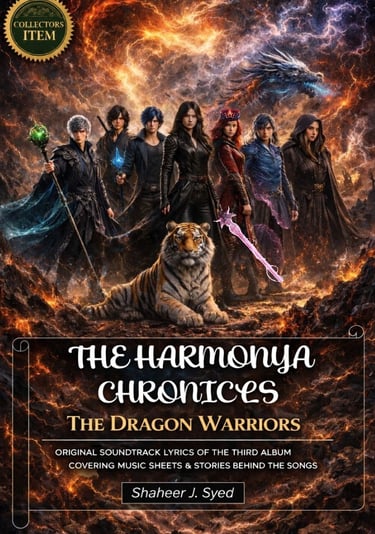
The Harmonya Chronicles Music Book 03: The Dragon Warriors. A Three-Lens Review: Publisher / Editor / Audience. The 3rd Music Review in the series of The Harmonya Chronicles reviews
Note: Album 3 — The Dragon Warriors scores the emotional arc of Books 09–13 of The Harmonya Chronicles — the Consequence Arc. It is the third of five music companion volumes produced under OBSIDIAN HEART. It can be experienced independently of the books, or alongside them. This is the darkest and most demanding volume in the music universe to date.
For the saga: Book 09 | Book 10 | Book 11 | Book 12 | Book 13
THE PUBLISHER'S LENS
Why Album 3 Is the Most Philosophically Demanding Volume the Music Universe Has Produced
Album 3 — The Harmonya Chronicles: The Dragon Warriors — marks the point at which the Harmonya music universe enters territory that franchise music rarely occupies: genuine consequence. Not the dramatic consequences of a battle lost or a character wounded — the structural, identity-level consequences of holding against something designed specifically to make holding impossible.
Books 09 through 13 represent the saga's consequence arc — the shift from will they win? to will they remain themselves? Album 3 scores that shift with fifteen tracks that refuse catharsis, decline resolution, and insist on witnessing what the prose of Books 09–13 was always carrying but could not fully deliver alone.
The author's declared theme is precise: consequence. Not escalation. Songs become witnesses, not narrators. The listener is placed beside the warriors in the aftermath rather than above the story watching events unfold. The music will not tell you what survives.
For studios and licensing partners, Album 3 presents the franchise's most significant artistic statement to date. The God Breaker Theme — precision without malice, mechanism without mercy — is among the most distinctive and philosophically articulate pieces of antagonist music in contemporary franchise scoring. Stay is the saga's most direct statement of its core relational philosophy. Echoes of the Forgotten is a memorial piece of genuine distinction: it witnesses civilisational erasure without consolation, without resolution, without the false comfort of meaning made from mass death.
These are not background tracks. They are philosophical arguments in musical form. An audience that encounters them through streaming or YouTube will find music that tells the truth about endurance and identity without the narrative scaffolding that typically makes such truth bearable. That honesty is the franchise's deepest asset and Album 3's clearest demonstration of it.
THE EDITOR'S LENS
Musical Architecture: Fifteen Tracks That Witness Without Resolving
Album 3 is built around a structural inversion of everything the preceding two albums established. Where Album 1 and Album 2 moved toward — toward emergence, toward transformation, toward the fellowship complete — Album 3 moves through. Through the weight. Through the identity erosion. Through the God Breaker's precision. Through the unglamorous endurance that does not feel like courage but is the only thing available.
The architectural principle governing all sixteen tracks is stated in the opening poem: "What endures is not what was strongest, but what was willing to remain answerable." Every track is a demonstration of what remaining answerable actually requires — and costs.
The opening poem — The Weight That Stays — is nine sections of philosophical verse that establish the album's register before a note of music is played. This is not scene-setting. It is a philosophical position being staked: endurance is not survival, it is an agreement; some trials do not attack but persuade; the centre that does not shift is fidelity to chosen identity, not faith in outcome. The album that follows enacts each of these positions across fifteen tracks.
The grief architecture of Album 3 is more complex than either preceding volume. Unfulfilled (Recharged) holds two responses to the same wound simultaneously — acceptance that integrates and obsession that weaponises — without judging between them. Ashes of All My Tomorrows witnesses self-erasure through relentless giving and offers no resolution because the pattern does not break simply by being seen. A Waking Dream holds separation without demanding reunion. These are not comfort songs. They are honest ones.
The transformation architecture deepens what Album 2 began. The River and the Flame scores change as the nature of love rather than its enemy. Ashes to Shadows scores transformation so complete that the person who entered is not the person who emerged — and the survivor's isolation that follows. Fractured Reflections scores the identity erosion that accumulates not through single catastrophic betrayals but through the slow drift of necessary compromises, mask by mask, until the self becomes unfamiliar.
The consequence architecture — the album's final movement — is where it becomes most demanding and most distinctive. Tracks in the Dust ends mid-step, refusing the false comfort of conclusion. Where All Threads Awaken ends on the moment before engagement, threads alive but work not yet begun. The Resonance of the Seven ends sustained rather than concluded — awareness of position already occupied, nothing broken, everything awake. The God Breaker Theme ends not in resolution but pause, implying continuation beyond the frame.
On Stay
This track earns separate attention because it is the album's philosophical centre — the statement that everything else orbits. Not a battle theme. Not a transformation anthem. The unglamorous labour of remaining present when presence offers no proof and no reward.
"Love isn't light, it isn't loud / It doesn't save the day / It's sitting on the cold stone floor / When there's nothing left to say."
The choosing is continuous, unqualified, not dependent on outcome. I will stay. I choose you every time. This applies to every relationship in the saga and to the saga's deepest philosophical claim: the reason to hold is not the vision of the victory. It is the specific life that would be lost if you didn't. Stay is that claim in its simplest and most direct musical form.
The most important thing to understand about this track is what it is not. It is not a rage theme. It is not a darkness anthem. It is the sound of precision — of a mechanism functioning exactly as designed, without emotion, without response to environment, without malice, without mercy. Not cruel: mercy is simply not among its parameters.
97 beats per minute, chosen specifically to deny both comfort and urgency. It does not panic. It does not hesitate. It proceeds.
This is what makes the God Breaker genuinely terrifying and what makes this track the most philosophically precise piece of antagonist music in the franchise: darkness that moves unburdened does not need to hate. It only needs to function.
THE AUDIENCE'S LENS
Two Ways to Experience Album 3 — Both Complete
For listeners arriving through the music first, Album 3 is a complete and demanding experience that requires no saga context. Stay belongs to anyone who has ever chosen to remain present to someone or something when presence offered no immediate reward. Echoes of the Forgotten belongs to anyone who has stood in the aftermath of an irreversible loss and found that no amount of meaning-making adequately addresses the absence. Unfulfilled (Recharged) belongs to anyone who has felt the fork in the road between integrating a wound and weaponising it.
The philosophy is present in the music without being stated. And unlike Album 1 and Album 2, which carry their emotional content with some sense of forward momentum, Album 3 simply holds. It does not move toward. It witnesses. For some listeners this will be the most powerful experience in the music universe. For others it will require time. Both responses are correct.
For readers who know the saga, Album 3 is the sound of Books 09 through 13 as they actually were — stripped of narrative scaffolding, left as pure emotional weight. The Echoes of the Forgotten is the sound of what the warriors were holding against across Books 12 and 13: not a villain's passion but a mechanism's function. Tracks in the Dust is the unglamorous reality of Book 13's endurance — not triumphant courage but the quiet refusal to surrender what cannot be seen. Fractured Reflections is the mirror held up to every warrior who looked at what they had become and found someone they did not immediately recognise.
On the Tracks That Refuse Resolution
Several tracks on Album 3 do not resolve in the conventional musical sense. For listeners expecting catharsis, this is the most important thing to understand going in: the refusal is the statement.
The consequence arc does not offer resolution. The God Breaker's damage does not unhappen. The kingdoms affected remain affected. The identities that eroded require conscious acts of will to rebuild — not a single moment of reclamation but a continuous choosing. An album that resolved these tracks would be lying. Album 3 does not lie.
The suspended chord at the end of The Rhythm of Peace leaves resolution as the listener's responsibility — because peace, the album insists, is not self-sustaining. It requires intention. The maintaining of it is the listener's work as much as the warriors'.
What Album 3 Leaves You With
The The Resonance of the Seven closes the album's main movement — seven voices moving independently through shared harmonic space, nothing broken, everything awake. It is the sound of the fellowship having passed through consequence and still being there. Not triumphant. Not resolved. Present.
That presence — maintained through everything the arc required — is Album 3's final statement. The question was never whether they would win. The question was whether they would remain themselves.
They did. They are here. Answerable. Awake.
VERDICT: 9.5 / 10
Album 3 — The Harmonya Chronicles: The Dragon Warriors — is the most philosophically demanding and most honest volume the Harmonya music universe has produced.
It scores the consequence arc of Books 09–13 not by dramatising the conflict but by witnessing it — from inside the weight, without consolation, without false resolution. Fifteen tracks that hold grief, identity erosion, unglamorous endurance, the precision of designed darkness, and the unglamorous labour of remaining present — all delivered in a form that the prose of those five books built toward and the music fully enters.
For listeners arriving through the music: a complete, demanding, and deeply honest emotional experience.
For readers who know the books: the sound of everything Books 09–13 were always carrying, finally heard without mediation.
Listen to Album 3 — The Dragon Warriors:
🔗 [player.harmonyachronicles.com](https://player.harmonyachronicles.com/)
🔗 [youtube.com/@OBSIDIANHEART_SE](https://www.youtube.com/@OBSIDIANHEART_SE)
Explore the full saga:
🔗 [www.harmonyachronicles.com](https://www.harmonyachronicles.com)
Album 1 was emergence. Album 2 was escalation. Album 3 is consequence. The question is no longer whether they will win. It is whether they will remain themselves.
Read Other Blogs
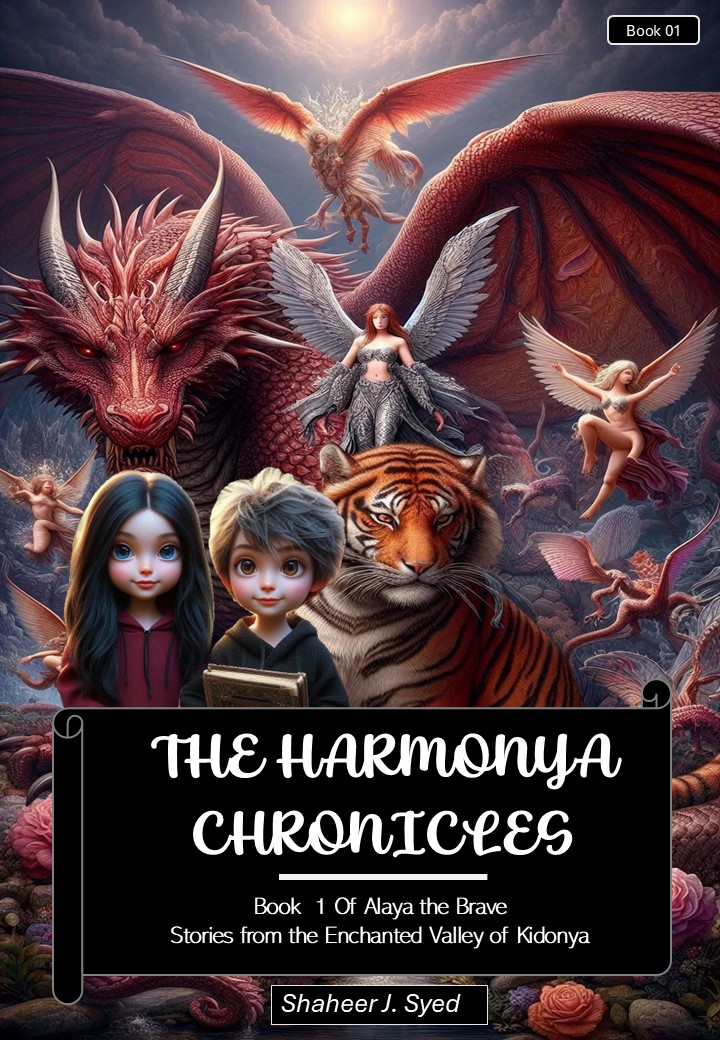
Start your Saga Journey with Book 01 of Alaya the Brave!
Continue your Journey with Book 02 of Alaya the Brave!


Why is Everyone Listening to "The Rise of The Storm Bringer"?


The Harmonya Chronicles Clubs!
Which warrior are you?
Join our warriors in their epic adventures today!
© 2023. All rights reserved.